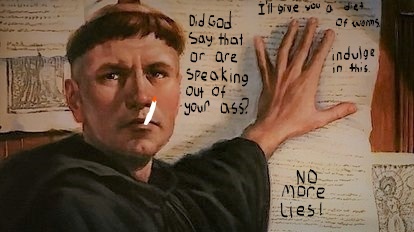
Few people have left a lasting mark on this World as much as Martin Luther. I think many people would be surprised to see all the ways that this sixteenth century German monk shaped the modern world. He opened the doors of free thought, peaceful revolution, separation of church and state, and he brought back the powerful love of the Gospel of Christ. He challenged the authoritarian church knowing that he might die for his beliefs, and yet he stood strong against a world that told him he was a terrible deceiver and a heretic. Martin Luther recognized that he was a sinner and he would admit that he made some mistakes throughout his life, but his conviction for God’s loving gospel was unwavering and it revolutionized the world.
In order for me to explain the impact that Martin Luther left I will need to first explain his cultural context and summarize the story of his life. If you want a more in depth look at Martin Luther’s life check out the biography Martin Luther by Eric Metaxas, or watch the biopic Luther directed by Eric Till.
Luther’s Cultural Context
Martin Luther lived in modern day Germany from the late 15th century until the mid 16th century. Much of modern Europe was part of the Holy Roman Empire and the German land was no exception. The Holy Roman Emperor functioned as the political and military leader, while the pope operated as the spiritual leader of the empire. Roman Catholicism was the official religion of the empire and to disagree with the Catholic church was heretical treason. If you were not willing to publicly agree with the catholic church often they would have you killed. This was the case for Jan Huss who had taken a stand against indulgences almost a century before Luther, Hus was burned at the stake for his stance. The pope had apostolic authority which meant he heard directly from God and anything he said could be held on par with scripture. The pope had spiritual authority over the living and the dead, so as you can imagine his words had immense power. The emperor led the empire into war and made laws, while the pope defined morality and told the people what was true.
The education system of Luther’s world was ran by the church, and the catholic faith was heavily intertwined into the curriculum that was taught. The church weighed in on areas far outside the theological spectrum; this includes astronomy as in the story of Galileo who was forced to recant his books after the Catholic church disagreed with his astronomical stances. The truth was sanctioned by the papacy (the pope). Books were expensive in this time, so reading wasn’t a casual hobby for most people. The 15th century invention of the printing press made mass publication possible for the first time, and books were becoming much more available to the public. The exception to this was the bible which was only read in Latin so that only the priests could read it, and then relay God’s word to the common people. The thought in the catholic church was that common people couldn’t understand God’s word on their own, so they needed to be told what it meant.
The catholic church of the early 1500’s were using the practice of indulgences. Indulgences were gifts of money to the catholic church that had “spiritual rewards.” Say your uncle died and was in purgatory, if you decided to buy a certain number of indulgences you could buy him a ticket to heaven and he could stop suffering for his worldly sins. The pope sanctioned the sale of indulgences to fund the construction of a number of cathedrals.
The Story of Martin Luther
Convictions of a Guilt Ridden Monk
Young Martin had no qualms with the church; he grew up thinking he was going to be a lawyer. Martin was very self aware of his sins against God and would often beat himself up for the things he did wrong. One day on his way from school back to his father’s home Luther was nearly struck by lightning; he was so frightened that he called out to Saint Anne (The mother of the virgin Mary) that he would become a Monk if he were to survive the storm. Soon after he dedicated his life to God as a monk. Martin Luther was an incredibly dedicated monk and he spent his days praying, studying, serving the church, and confessing every single sin he could think that he may have committed. Martin was tormented by a fear of death and damnation, so he did everything he could to justify himself in God’s sight. He could never feel that he had done enough so he just kept working harder and harder to save himself. Luther’s friend and spiritual mentor in the monastery Johann Von Staupitz noticed Luther’s endless sense of guilt, and he wanted to make it clear to Luther that God was a God of mercy and love, rather than a God of punishment. Luther decided to heed his mentors advice and he started to study the Bible rather than the other writings the catholic church encouraged him to study. One day while Luther was stuck on the shitter reading the bible he happened upon Romans 1:17 which made clear to Luther that we were saved not by our own actions but by faith in the forgiveness offered by Jesus Christ. This revelation shocked Luther to the core, he realized God wasn’t trying to pick and pull his life apart. God wanted to save him from judgement through Jesus’ sacrificial death on the cross. After his revelation of God’s grace Luther was sent by Von Staupitz to study, teach, and preach at the university of Wittenberg in Saxony, Germany. In Wittenberg Luther received his doctorate of theology and became a professor at the university and a priest of the local church.
This revelation freed Luther from the guilt that so often ensnared him, and he wanted to share this truth with everyone. Luther began to preach about God’s mercy and love in Wittenberg, and he caught the attention of the prince/elector of Saxony Frederick III. Frederick stood at odds with Luther’s views on christian relics; Luther doubted the legitimacy of most relics and he felt that worshipping/honoring them was foolish. Frederick III had amassed a vast collection of Christian relics and valued his collection. This issue began a long discourse between Frederick’s secretary Spallatin and Martin Luther. Spallatin challenged Luther’s teaching on relics, but as he and Frederick understood more of Luther’s view they began to relent. Frederick III and Spallatin developed a liking to Luther and his teachings which became a very important relationship for Luther. Soon after this revelation of God’s grace the church started to sell an indulgence to fund the building of St. Peter’s Basilica; when people bought this indulgence it was said that people suffering in purgatory would be sent to heaven. Luther thought that this teaching was a load of crap because it was contradictory to God’s FREE gift of grace. Martin decided to write his famous 95 theses to criticize the churches’ practice of indulgences. He posted his theses on the door of the church in Wittenberg, and soon it was published and spread across Germany and the greater Roman empire. This pissed off the higher elite of the catholic church including the pope himself. The elite of the catholic church decided that Luther needed to recant his statements against indulgences as they contradicted canon law set by a previous pope; and were therefore heretical. Luther was brought to a hearing in Augsburg as well as a hearing at the Diet of Worms (A meeting of the holy roman emperor and the princes of Germany). In the latter hearing he stood by his criticism of indulgences in front of the emperor himself. Luther was not willing to speak against the truth that he had found in God’s written word. Unless someone would convince him through the Bible he was not willing to change his stance, even if that meant death.
From the time Luther posted the 95 theses in 1517 to the time of the diet of worms in 1521; Luther grew a large following in his views that challenged the Catholic church. Luther’s writings were spreading across the Roman empire, and the people of Wittenberg openly embraced Luther’s teaching. Fellow theologians and teachers in Wittenberg joined Luther in challenging the church; men such as Andreas Karlstadt, Philipp Melanchthon, and Justus Jonas. After Luther’s stand at the diet of worms Luther was outlawed and ordered to be killed by Emperor Charles the V. This could have been the end of the story; just another revolution squashed by the authoritarian catholic church, but this time was different.
Frederick III was a powerful friend for Luther, he was in attendance at the Diet of Worms, and he agreed with most of Luther’s views on Christianity. The pope wanted the second trial to be held in Rome, but Frederick III persuaded the emperor to have the trial in Germany. Frederick also negotiated safe travels to and from the hearing for Luther. Luther was able to leave Worms and head back to Wittenberg, and on his way home he was kidnapped by a group of marauders. These men were sent by Frederick to take Luther to the Wartburg Castle to hide Luther away from the public. Luther was taken to a tower in Wartburg castle where he would stay for the better part of a year. Luther was hidden away in isolation, he had his bible; a bed; three meals a day; and more alone time then he knew what to do with. He had been thinking for some time about translating the Bible into the common tongue of German, because most people didn’t know Latin. He wanted the people to be able to experience God’s truth for themselves. He spent his time in Wartburg reading the bible, translating it, praying, fighting depression, and battling his fierce bowels. The only person who knew where Luther was hidden was Spallatin, many in Wittenberg thought Luther was dead. Frederick had even asked not to know where Luther was hidden. Spallatin and Luther wrote back and forth about what was going on in Wittenberg, and Spallatin would send Luther anything he needed for his writings.
The New Old Church?
This departure from the catholic church stood in opposition to a 1000 years of church history. Tradition, authority, and truth were all brought into question through the protests of Martin Luther. It is clear to see what Luther stood opposed against, but what did he stand for? Two latin phrases summarize the new theology that Luther looked to bring about, Sola Scriptura (only scripture) and sola fide (only faith). Sola scriptura meant that only the Bible was God’s established word to mankind. Sola fide meant that only by faith in God’s gracious forgiveness could a man be saved. These core points stood in opposition to the pope, catholic canon law, purgatory, indulgences, and a plethora of other practices and beliefs of the catholic church. Luther would not bend on his convictions and the catholic church would not bend on their traditions, thus we have the biggest division in church history.
Things in Wittenberg were moving along smoothly… oh wait that’s complete horse shit. The people of Wittenberg saw the banishment of Luther as a statement that the Catholic church was not willing to change, which Luther had progressively figured out before the Diet of Worms. Andreas Karlstadt decided he was to lead this revolution in Luther’s place. As radical as Luther was Karlstadt made him look quite tame. Karlstadt saw the ritualistic legalism and rigid structure of the Catholic church as a large issue and wanted dramatic change as the Wittenberg christians looked to rekindle the practices of the church in Acts. One way Karlstadt looked to do this was to destroy the statues and iconic imagery of the church in Wittenberg. He felt that iconic imagery was more akin to idolatry than genuine worship of God. Karlstadt even spoke against owning crucifixes as they had lost connection with the pain and suffering that Christ had done on the cross and become more of a symbol of ritualism. Karlstadt got rid of his priestly garb and started wearing street clothes as he preached. Karlstadt wanted radical change and he wanted it to come immediately, many of his ideas seem to be rooted in truth. The problem with Karlstadt’s practices at this time is that with all these changes it was hard for the church to keep a clear emphasis on what they wanted in this new movement. Spallatin wrote to Luther about the changes that he had seen occuring in Wittenberg under Karlstadt and he asked Luther to come out of hiding early in order to come help the church in Wittenberg. At this time Luther had anticipated Melanchthon to become the leader in Wittenberg, and when he heard of Karlstadt’s leadership he gave these words to bolden Melanchthon to be a strong leader.
Be a sinner and sin boldly, but believe and rejoice in Christ even more boldly, for he is victorious over sin, death, and the world. As long as we are here (in this world) we have to sin. This life is not the dwelling place of righteousness, but as Peter says, we look for new heavens and a new earth in which righteousness dwells. It is enough that by the riches of God’s glory we have come to know the Lamb, even though we commit fornication and murder a thousand times a day. Do you think that the purchase price that was paid for the redemption of our sins by so great a Lamb is too small.
During Luther’s stay in Wartburg he hadn’t shaved and he grew a long beard, near the end of his time there he could leave the castle as long as he pretended to be a German knight. Luther kept this look as he traveled back to Wittenberg, and when he arrived he looked quite different from the man who had left a year before. People were excited to see that Luther was alive, but the excitement didn’t last long. Luther knew that this was a tumultuous time for the church in Wittenberg and he wanted to help establish stability in this important moment. Karlstadt had even gone and married within this time, with all the change Karlstadt was directing the church in Wittenberg was becoming a radical movement tearing down everything they felt held the church back. Luther wanted to keep the focus on the gospel and he felt that Karlstadt was moving too quickly. Karlstadt and Luther’s disagreement sparked a division within the new protestant movement which saw Luther as more conservative and men like Karlstadt and Thomas Muntzer as more radical. Muntzer and other radical leaders who had ran with Luther’s criticism of the catholic church looked at this moment as a time for a great uprising where the serfs and common folk could take power from the established rulers of there land. This revolt led to the Peasants War of 1525 where the peasants fought the holy roman empire in Germany to take political sovereignty over their land. Although this revolt was inspired by the renewed ideas of Martin Luther that questioned the catholic churches’ authority and gave the Bible to the people; Luther didn’t support the political uprising of the German people. He felt people should stay under the government that God had put in charge of them. He believed that through peaceful protest necessary change could be brought about, so he didn’t agree with violent uprisings against the established authorities. Throughout Luther’s reformation movement he never encouraged violent revolt, so he aligned himself with the German princes to stop what he felt would be a hindrance to the movement of the gospel. Eventually the peasants lost to the far more advanced military of the holy roman empire. Luther wanted change within the church, but he didn’t see a need to leave the empire as long as they could protect their religious freedoms. After Luther’s return in 1521 Karlstadt left Wittenberg to pursue his vision for the church elsewhere. Luther returned his focus to translating the Bible into German with the help of Philip Melanchthon; his friend and greek scholar. Luther preached the gospel of God’s love to the people and looked to give full access to God’s word to the common folk.
Luther had opened the floodgates for people to find new interpretations of the Bible, this was predominantly good in that it opened more doors to religious freedom and free thought. However, many people interpreted the Bible differently and looked to change previously established thought. Certain radical propositions from these men could lead to real damage. This is a risk that Luther thought was well worth it; he felt that God’s word would unify people in how he understood the bible. In many ways he was right, the reformation brought back the centrality of the gospel. However many secondary truth’s were interpreted differently and led to much division with the protestant movement. These divisions became the different denominations of the protestant church.
Luther completed the German translation of the new testament in 1522. Luther, Melanchthon, and their contemporaries in Wittenberg looked to revolutionize Christianity through teaching and writing about their “new” ideas. With Karlstadt out of Wittenberg Luther and Melanchthon tried to envision what the church could become. They wanted to focus their changes on what was important to the Christian faith, everything else needed to be peripheral. The book of Acts gave them a framework for what a gospel driven church could look like. That being said they wanted to avoid unnecessary change as it could be a barrier to people receiving their message. The catholic church created a very rigid and ritualistic church experience, this would quickly lead people towards legalism and works, and take them away from the personal relationship God wanted with them. Luther and Melanchthon looked for ways to make church more understandable and relational. One way Luther did this was by writing hymns and encouraging singing in the church, much of the music sang in church before this time was latin gregorian chant. Luther wanted people to emotionally connect with God’s love and grace through song in their own tongue, that way people could connect with the lyrics. Luther and Melanchthon also looked to remove the hierarchy established within the catholic church. Priest’s had become mediators between common folk and the Lord, and priests were necessary to practice the sacraments. Luther saw all christians as part of a brotherhood of priests, everyone could pray and read God’s word. They rejected the idea that priests couldn’t marry as a catholic invention, so with these ideas in mind the leaders in Wittenberg started to marry off. in 1526 Luther married a runaway nun who had escaped her monastery and ran to Wittenberg. Martin and Katharina’s marriage was in itself a statement, a Godly leader could marry. They had several kid’s together and their family served God together.
You may be asking why the holy roman empire didn’t just wipe out all protestants at the very beginning. For starters Luther’s writings were spreading all over the place (largely due to the invention of the printing press), and the protestant movement was steadily gaining traction. Secondly, Frederick the elector and prince of Saxony held strong political sway in the empire. The emperor needed German help to fend off an upcoming turkish invasion. Frederick and the other German princes were able to leverage Luther’s protection as they supported the emperor’s military against the Turkish forces. Frederick and his secretary Spalatin stand as crucial characters to this story as they protected Luther and the protestant’s religious freedom and dissent.
In 1530 and 1531 Phillip Melanchthon presented the Augsburg confession which outlined the Lutheran faith to the roman emperor. This led to a temporary time of peace that held til the mid 1540’s. The emperor allowed protestant practices during this time and when he got back around to fighting this theological war it was too late, protestants had become a large enough force throughout the empire that they couldn’t be stopped.
Throughout the 1530’s Luther, Melanchthon, and the faithful in Wittenberg strived to create a church that would honor the gospel of Christ. Obviously they weren’t perfect and they had a difficult time bringing a solid consensus of theology to the new church. One thing that remained central throughout this time was God’s grace and mercy through Jesus Christ. These theological disagreements were the beginnings of what became a plethora of protestant denominations who disagreed on important theology or overemphasized a peripheral point of theology. Luther finished his translation of the Bible into German which put God’s word into the hands of the people. People saw that they could personally interact with God through the scriptures and prayer. This was a revolutionary new idea that gave people the ability to take God at His word and not that of an ordained priest.
Martin Luther died of a stroke in 1546. This came three years after one of the biggest blemishes of his life where Luther wrote harshly against the Jews as he said they had murdered Jesus. Luther hated that jews wouldn’t turn to christianity and felt that they were stubbornly denying the truth. These writings late in Luther’s life were used by Adolf Hitler in his persecution of the jews throughout the holocaust.
Phillip Melanchthon gave these words as part of a eulogy for Martin Luther.
“Luther brought to light the true and necessary doctrine. He showed what true repentance is, and what is the refuge and the sure comfort of truth which quails under the sense of the wrath of God. He expounded Paul’s doctrine, which says that man is justified by faith. … Many of us witnessed the struggles through which he passed in establishing the principle that by faith are we received and heard of God. Hence throughout eternity pious souls will magnify the benefits which God has bestowed on the Church through Luther. …. Some have complained that Luther displayed too much severity. I will not deny this. But I answer in the language of Erasmus: “Because of the magnitude of the disorders, God gave this age a violent physician.”… I do not deny that the more ardent characters sometimes make mistakes, for amid the weakness of human nature no one is without fault. But we may say of such a one, “rough indeed, but worthy of all praise!” If he was severe, it was the severity of zeal for the truth, not the love of strife, or of harshness. … God was his anchor, and faith never failed him.”
The Lasting Impact Of Martin Luther
Impact on Free Thought
Luther was an early revolutionary for free thought. Luther stood tall against an authoritarian Roman government while knowing that his words could cost him his life. When the government has the ability to define truth without question they are able to silence the people and dictate the course that a country will take. We see this today in North Korea where the government lies to it’s people in order to protect it’s power. He challenged the established catholic church because it viewed truth as important tradition rather than a timeless reality that is plain to people through reason. He viewed his dissenting words as constructive towards society even if they challenged the human authorities. The spread of Luther’s writings and the movement that followed showed the watching world that if you convince people through reason true belief can be a powerful force that can challenge authoritarian regimes. Luther also saw that disagreement could be constructive in that people could decide for themselves based on the evidence what was true. Allowing dissent and discussion protects human freedom and allows us to express what we truly believe, and when our real thoughts are on display we are able to challenge and change our wrong beliefs. Luther’s rebellion laid a foundation for the first amendment’s protection of free speech.
To take this point even further Luther prepared the path for free religious thought. Throughout human history the church and state were nearly inseparable, I think to the Greek’s, Egyptians, and Persian’s whose faith was part in parcel with their governments. Faith wasn’t a free enterprise based on belief, but was something that was part of the culture and government that you lived in. Luther thought that faith should be placed in the truth regardless of government or culture. He would debate and argue his faith with reason in order to show people the reality of what he believed. He practiced the faith that he truly believed and he inspired others to think about their own beliefs. He was a precursor to the freedom of religion that we have in America. He also inspired many people to move in order to practice their true beliefs as many early european americans did.
This isn’t to say that every thought is as valid as another or that people with access to scripture couldn’t develop their own wrong theology. There are religious sects who seek to deceive others under the guise of religious freedom, and some are successful. However this put’s responsibility for one’s own faith in one’s own hands rather than in the hands of those in authority. We as people are fallible and not perfectly rational, as is displayed by the Popes of the 13th through 15th century who lead people towards purchasing their salvation for personal gain rather than standing firm on loving truth. So while free thought and belief have their risks it is far better for people to lead a life lead by conviction of truth than in blind submission to one’s government, culture, or church. This is a conviction that Luther fought for even as he continued to argue with the radical protestants of his time that took his views and went much further.
Sola Fide and Sola Scriptura
(Only Faith and Only Scripture)
The catholic sacraments were considered by most at the time the means to forgiveness and salvation. This lead people into a legalistic mindset; as practicing the practice was the way that you could earn your salvation. Through years of wretched guilt and intense study of the Bible; Luther grew a strong conviction that fallen mankind could not earn their salvation. The salvation God offered is a free gift of divine mercy and forgiveness. The idea that we could earn our salvation puffed up mankind while disregarding God’s loving mercy. Further, the idea that salvation could be bought sickened Luther and he could not sit back and ignore that this was a widely held belief. Faith in God based on His revealed truth is what God stated as humanities way to salvation, not through righteous living and good deeds. Jesus continuously admonished the pharisees because he saw this in his day, and Luther lived the life of a pharisee and saw just how unsatisfying and unhelpful it truly was in following God and having a relationship with Him.
Another huge contribution Luther brought back to the forefront of Christianity was that only the Bible was God’s written truth to mankind. Popes throughout the centuries have written edicts or statements that were held to be inspired words of God by the Catholic church. Martin Luther read many of these statements from the Popes and he felt strongly that they had fallen mankind’s fingerprints all over them and not much of God’s. The Pope’s would contradict the Bible and their writings started harmful practices like indulgences. The Bible was written by God’s prophets and apostles, these men were profound men of faith who suffered victoriously to follow the creator of the Universe. The popes were often vile men who fornicated; led by unquestioned authority; and contradicted the word’s that the unchanging God had lead the prophets and the apostles to write. The popes didn’t suffer for the faith in the way that all of the apostles had and the argument of apostolic succession was based on a couple obscure verses that were misinterpreted. The catholic church also held that tradition was a strong basis for the truth that they shared, Luther on the other hand felt that truth should be self evident. He experienced the truth of God’s word in scripture and he saw evidence that contributed to it’s validity; he didn’t see the same with the writings of the Popes. Luther stance here stood as a firm basis of theology coming from the Bible (God’s written word) rather than being in the church practices or writings of the Popes. If the church dictated God’s truth than a small amount of leadership had the ability to rule what is truth. God’s word being something that God intended to be shared with the world was for each individual to hear truth directly from God and left for them to properly apply to their own lives. When an investigator looks for truth he doesn’t merely question the witnesses and blindly follow their testimony, he compares the testimony with the objective facts; and when he harmonizes these two lines of evidence he develops a case that he feels represents the truth. If we blindly follow witness testimony without considering the facts in a case we are forced to trust and follow fallen human beings wherever they wish to lead us. God showed Luther the faults in church tradition and papal edicts and this helped Luther to know where he could turn to hear directly from God. This lesson was an incredibly helpful one for people to learn who wanted to hear from God and Luther shared this lesson while providing people with the ability to read God’s words for themselves.
Peaceful Protest For Reform
When Michael King Sr. visited Germany he studied the history of Martin Luther and was so inspired that he changed his and his son’s name to Martin Luther King Sr. and Martin Luther King Jr. Centuries after Martin Luther; MLK lead a reform that used many of Luther’s tactics of peaceful protest and arguing the truth rather than violently hurting others to achieve reform. Martin Luther was obviously inspired by Jesus who instead of being the conquering king the Jews wanted him to be was a peaceful rebel that shared the truth in love. Martin Luther didn’t want people killed in order for him to get his way, but he wanted people to know what he had been convicted to see as the truth. The war that Luther fought was a war of rhetoric and he made it his mission to convey the truth through his writings, sermons, and public debates. Gandhi and MLK looked to Luther’s victorious peaceful rebellion against the Catholic Church as proof positive that change could be made without bloodshed. This isn’t to say that people were not killed in the reformation movement that Luther started; however Luther fought any ideas of a violent rebellion against the Holy Roman Empire. Luther was steadfast against the protestants who wanted to turn the reformation into a political rebellion; he felt this would take the emphasis of the movement away from the gospel message. We saw in the peasants war that some tried to make Luther’s writing into a pre-Marx communist manifesto; however the point’s Luther made toward human equality were much more about their relation to God and less about socioeconomic class. He wanted the gospel message to be heard by everyone and didn’t want to stifle anyone from hearing the truth based upon cultural status or class.
God Works Through Broken People
Martin Luther battled depression and severe bowel issues throughout his life. He was at times vulgar in his language; and he often used curse words in his native german tongue. In my humble opinion Luther’s theology was by no means perfect, he practiced infant baptism; wrote harsh words against the Jews; and he believed that communion bread and wine were indeed turned into Jesus’ blood and body. There are other issues I have with his theology but that should suffice as a brief list. Martin Luther was wrecked with guilt as a young man, and he would probably be the last person to claim he was perfect. All this being said God used Luther to change the world and bring the gospel message back to the forefront of Christianity. For centuries the idea of salvation as a free gift of God was all but forgotten, and through this man God reminded the watching world that He was a loving and merciful God who desired a personal relationship with each and every person. God’s fingerprints are all over Luther’s story as he convicted Luther of the truth, and answered his deepest darkest questions. God enabled Luther to speak to the world through the printing press. God protected Luther from those who wanted him killed through his Prince Frederick. This story displays God’s power and his ability to change the world through us if we are willing to listen to his calling. This lesson is all over the Bible (i.e. Paul, David, Peter, Matthew, Samson, Abraham, Moses, Esther, Ruth, Noah, and Jacob to list a few examples), but in case you weren’t aware God is powerful and he can use broken sinners to change the world for the better.
Work Cited
Quotes
Metaxas, Eric. “Martin Luther.” Martin Luther, edited by Eric Metaxas, Viking, 2017, pp. 257–257.
Metaxas, Eric. “Martin Luther.” Martin Luther, edited by Eric Metaxas, Viking, 2017, pp. 431–431.
Sources
Metaxas, Eric. Martin Luther. Viking, 2017.
Till, Eric, director. Luther. Luther, MGM Home Entertainment, 2004, http://www.imdb.com/title/tt0309820/?ref_=ttco_co_tt.
 Frankly Put
Leave a comment