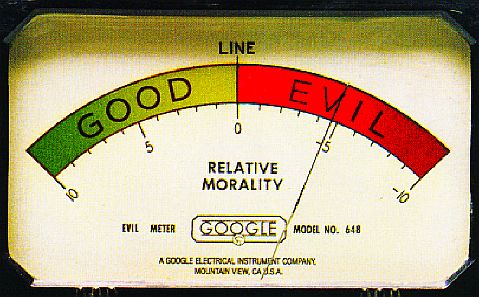
I am writing this paper to answer the question of whether the belief in objective morality can be logically held without also believing that there is a god. The conclusion that I have come to after deeply pondering this question is that the only logical basis for an objective morality is a god. First I will briefly answer the question; is it logical to believe that objective morality exists? This first question may seem unnecessary in order for me to argue my thesis; to that I would say my thesis wouldn’t matter if it was illogical to believe in an objective morality. Then I will answer the question; if objective morality exists, why would there have to be a god?
The first thing that I want to point out is that I think it is safe to say that most people would agree with the idea of objective morality. What I mean by this is if you walked up to anyone and asked them whether the holocaust was wrong, they would probably say “yes, it is.” That is a claim that only can be made under the presupposition that there is an objective morality. Objective morality is the idea that some things are inherently good (such as the concept of love), and other things are inherently bad (such as killing an innocent bystander). Most people subscribe to this idea that it doesn’t matter what people have experienced, think, or feel when it comes to what is good and what is bad. Now the knowledge that most people subscribe to this idea in itself does not prove that there is an objective morality, but there is no way to completely and empirically prove objective morality.
If there is no objective morality than there is no concept for someone who is morally better than someone else. Francis Beckwith points out “First, if there are no objective moral norms that apply to all persons in all times and in all places, then certain moral judgements, such as the following cannot be true Mother Theresa was morally better than Adolf Hitler; rape is always wrong; and it is wrong to torture babies for fun. But to deny that these judgements are universally true seems absurd. For there seem to be some moral judgements that are absolutely correct regardless of what cultures or individuals may think.” The conclusions that you can come to when you think under the precept that there is no objective morality are limitless in the scope of what is morally permissible, that is because under that precept everything IS morally permissible. So if you want to be able to declare any action as absolutely right in the scope of morality you must believe in objective morality.
The last point I want to make is that your life doesn’t matter morally unless there is an objective morality. You may be able to do something that no one else ever did but you cannot do one thing that is absolutely morally right. All of your actions would not matter in absolute morality so nothing you do will raise your moral standing because it doesn’t exist. So do whatever you want, it doesn’t matter. If you wanted to kill someone then why wouldn’t you? That last sentence probably makes you feel uneasy because you think that murder for fun is absolutely wrong which indicates you probably subscribe to the idea of objective morality.
You probably agree that there are things that are universally morally right, so why does that mean there has to be a God? I would like to answer that question with another question which is, on what basis are things morally right? I can only think of a couple possible answers to this question. The first answer is that objective morality is inherent to human nature. There are some problems with this idea like how can human nature hold us to be morally accountable. First you say that there is the justice system set up by human beings, but what about the people who get away with crimes. Then you say well our conscience holds us morally accountable if we are bad people we will have a conscience that tears us up on the inside. The problem with that is there are people who are insane whose consciences don’t work, also people have different consciences that make them think certain things are right even if most people would disagree.
The only basis for moral accountability is an afterlife in which something or someone judges the morality of our actions. In order for that to work this thing would have to be able to see our actions in order to judge them. So this thing would see all of our actions and judge us on whether our actions are morally right. How does it have a basis for what is morally right? through it’s nature. The nature of what we will now call God would be the basis for objective morality. This is what William Lane Craig said about this “On the theistic view, objective moral values are rooted in God. God’s own holy and perfectly good nature supplies the absolute standard against which all actions and decisions are measured. God’s moral nature is what Plato called the “Good.” He is the locus and source of moral value. He is by nature loving, generous, just, faithful, kind, and so forth. Moreover, God’s moral nature is expressed in relation to us in the form of divine commands which constitute our moral duties or obligations. Far from being arbitrary, these commands flow necessarily from His moral nature. In the Judaeo-Christian tradition, the whole moral duty of man can be summed up in the two great commandments: First, you shall love the Lord your God with all your strength and with all your soul and with all your heart and with all your mind, and, second, you shall love your neighbor as yourself. On this foundation we can affirm the objective goodness and rightness of love, generosity, self-sacrifice, and equality, and condemn as objectively evil and wrong selfishness, hatred, abuse, discrimination, and oppression.”
There is no better answer for why morality exists than that God created it. You could say that it was created by evolution as a means of survival. The problem with that is the scope of evolution is natural selection which would tend towards survival of the fittest. We as humans believe it’s right to care for the poor and help the needy. Wouldn’t that go against our evolutionary goal of survival of the fittest. If we are wasting our time on someone else then we can’t spend our time making our lives better. We say that it’s morally right to lay your life down for someone else’s; that just doesn’t seem to make evolutionary sense. So if morality exists and is not something that stemmed out of evolution then what did it stem out of? The best explanation seems to be a God.
The afterlife is a key part of this whole equation because if this life is all that there is then why wouldn’t we do what we wanted all the time. If there is no moral accountability then does morality even matter? No! If you want to live a life built on truth then you should know that if a God doesn’t exist it doesn’t matter what you do you’re gonna end up doing the same thing in the same place no matter what you do or how you do it. If there is no afterlife it doesn’t matter if you do something that will outlive you because you won’t be able to experience it after you die so nothing matters at all without there being an afterlife or moral accountability. When I say nothing I mean nothing because everything will die at some point; even the universe. Everything that has ever happened to you or that will happen to you will fade away into complete nothingness and mean nothing.
Since it would seem that there is objective morality, and the best explanation for an objective morality is a God, it would make logical sense that if objective morality does exist then God would probably as well. If objective morality does somehow existed without God, then it wouldn’t matter. If objective morality doesn’t matter then why would we care whether we lived moral lives? I don’t see a reason why it would matter. So it would seem that if there is an objective morality that does matter then there is a God.
Work Cited
Beckwith, Francis. Do the Right Thing: Readings in Applied Ethics and Social Philosophy.
Belmont, CA: Wadsworth/Thomson Learning, 2002. Print. Page 16
William Lane Craig “The Indispensability of Theological Meta-ethical Foundations for Morality.” Foundations 5 (1997): 9-12.
 Frankly Put
Leave a comment